A day at the office
A regular day at a PRCS control room turns into a three-hour struggle to rescue six-year-old Hind Rajab from a car under fire.
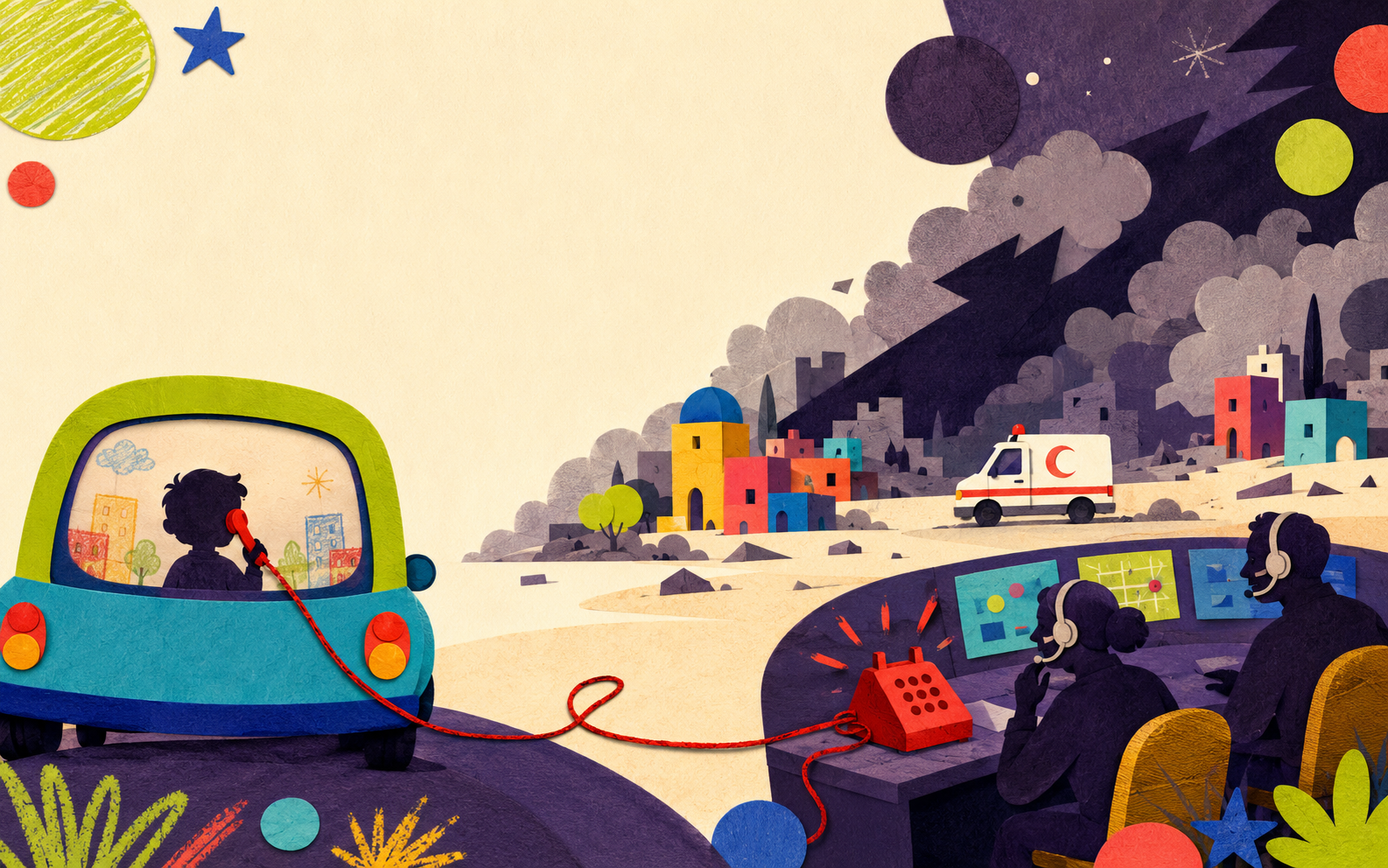
A kid’s voice: “They are shooting at us. The tank is next to me.”
“Gunshots, gunshots, gunshots.”
PRCS operator: “Hello? Hello?”
Line disconnects.
It is a regular afternoon in the office. A raging war zone exists; every minute, many people are dying and calling for help. You pick up the calls, intercept the situation, and assure the victims that aid will arrive. You coordinate with the authorities and send aid and assistance to the needful—same ol’. As a Palestine Red Crescent Society (PRCS) response coordinator, like any other day in the office, it’s 2:30 in the afternoon. Another distress call rings, and you prepare yourself to ace it in sending aid and help to the victim. But when you hear the other side—a weak, begging vibration with a loud background score—it wakes you up.
A family of six, with 6-year-old Hind Rajab, in an attempt to evacuate the Tel al-Hawa neighbourhood as ordered by the Israeli army, stops at the gas station to make themselves safe from all the bullets showering upon them. Then, at 2:30, a distress call rings at the PRCS control room.
Another operator dials back. This time, it’s again a weak, fearful but different voice of a kid that responds. Hind Rajab answers the call and informs the operator that Layan (her cousin, who called the first time) has also been murdered. Rana Faqih, the disaster preparedness and response coordinator from PRCS, takes over the call to send any kind of aid to that 6-year-old kid surrounded by the dead bodies of her family while a machinery eagle preys on her.
The network in the war zone is not very clear, so the call keeps disconnecting and reconnecting several times. In whatever sentences Rana and Hind can exchange, Hind only asks her to stay on the call, send help, and rescue her. Rana has to assure herself and Hind at the same time that help will reach Hind. Rana is terrified by the background noise of a tank moving and bullets blazing against the car.
Working in a war zone as a response coordinator can be a distressful job. You have to keep your calm, and with every ounce of strength, you have to pick up “the call,” talk in a calming and assuring tone, and believe that help will reach everyone. This is all you can—and have to—do. But there is a limit to that belief. At last, we are all humans seeing humans die at the hands of monsters—apologies, at the hands of humans.
From the bright afternoon, the sun is now setting. For Hind, bullets are reaching her faster than the seconds, and Rana is there, sitting in the control room with an ambulance all geared up for assistance. Yet both have to wait for three hours, as they are denied permission to send aid.
Somehow, with all the coordination, an ambulance with its sirens off reaches the gas station. As they are in contact with the control room, trying to pinpoint Hind’s location, they hear a blast.
Line disconnects again.
This time, no reconnection is established.
Nearly two weeks later, when the Israeli military vacates the area, Hind’s uncle finds the car with the bodies of everyone, including the 6-year-old, and, within some distance, an ambulance with two paramedics dead.
No approved comments yet. Be the first to start the argument.